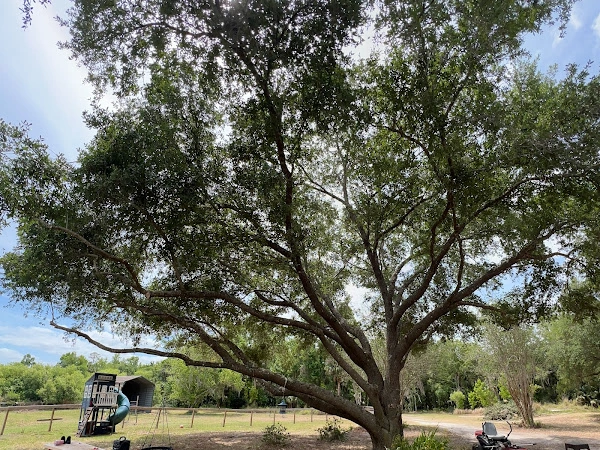
Ever walk past a tree on your property, one you’ve had for years, and something just feels off? Like, it’s not looking right. That’s usually how it starts. Little changes. You notice bark coming loose or branches that don’t look alive anymore. Sometimes people wait, hoping it’ll bounce back after the next rain. Usually it doesn’t.
Florida’s rough on trees. Hot, wet, windy, and the soil shifts more than you think. Then with storm season? That tree that looked completely fine in May could be dying by August. Here’s what to look for if you’re not sure if your tree is dying:
1. Bark Is Cracking or Peeling Away
Bark’s like skin. It protects everything underneath. When big sheets start coming off or it cracks deep enough you can see dry wood, that’s bad. Sometimes it’s heat, sometimes rot, sometimes both. You’ll see areas that look baked or even sunburned.
I’ve seen folks try to peel it off thinking it’ll “help it breathe.” It won’t. That bark isn’t supposed to move once it’s gone. If you’ve got large bare spots or the trunk looks split in more than one place, it’s already struggling.
In our weather, that kind of damage spreads quickly. Rain gets in, insects move in, and before long the inside’s soft.
Honestly, once it hits that point, it’s time to call a professional, and they can tell you if there’s a chance the tree can be saved by pruning or not (either way you want a plan before a storm makes one for you). You can always check our pruning info here.
2. Mushrooms or Fungi Growing Around the Base
Are mushrooms showing up around the roots? That’s not a good sign. (I’m not talking about the random ones that pop up after a week of rain,I mean the ones hugging the trunk or growing from cracks in the bark.) Those feed on dead wood. That means something under there’s already dying.
You might notice soft ground or spots that sound hollow when you knock on the trunk. That’s decay moving up from the roots. And the problem with that is you can’t see how far it’s gone till it’s too late.
Florida’s humidity speeds that up, no question. I’ve seen trees go from looking fine to unsafe in one season. So if you see fungus right at the base, it’s worth getting checked before the next storm rolls through. We handle inspections for this stuff every week — here’s where you can book one.
3. Dead or Brittle Branches That Snap Easily
Healthy branches bend before they break. Dead ones just crack. You’ll hear it. Dry, sharp, hollow sound. That’s the part that worries me most during storm season.
When the tree starts cutting off nutrients to the ends, those branches die first, and if they’re hanging over your driveway, the roof, or your neighbor’s fence, that’s when you’ve got real risk.
I tell people to look up at the crown. If you see whole sections without leaves while the rest looks normal, that’s not just random shedding. That’s decline.
You can trim some of it, but if half the canopy’s gone dry, the tree’s not coming back. Call for help before the wind does it for you. Our emergency team’s always on standby.
4. Sparse or Discolored Leaves
When a tree’s leaves go patchy or pale, something’s off underground (sometimes it’s pests, sometimes disease, sometimes poor drainage, sometimes all 3).
Florida trees have their quirks. Oaks will drop leaves late, magnolias hold too long, and maples get that yellow edge before they fade. You just have to know what’s normal for your yard.
If it’s dropping too early or looks uneven year after year, that’s when I’d start worrying. There’s a good write-up from the University of Florida’s IFAS Extension that backs this up — says off-season leaf loss is one of the first real indicators of decline. It lines up with what we see out here every day. (Source: University of Florida IFAS Extension)
5. Leaning Trunks or Exposed Roots
A tree that used to stand straight shouldn’t start leaning more each month. If it does, that means roots are shifting or breaking. And once that happens, you can’t fix it by staking it down.
Sometimes the soil gives out after weeks of rain. Sometimes a root rots from the inside, and you won’t see it till the tree tilts. The roots might even push up out of the ground on one side — that’s a clear sign it’s lost its grip.
Florida’s sand doesn’t help. Trees tip easier here than in clay soil. I’d say if you see cracks forming around the base or the ground lifting on one side, get it checked now, not later. We’ve pulled too many of those after storms.

What To Do If You Notice These Signs
You don’t have to decide right away whether it’s doomed or not. Most people can’t tell. Sometimes pruning and care help, sometimes not. The point is don’t wait till it’s hanging over the house.
At All Southern Outdoor, we’re local. We’ve been doing this a long time in Seminole and Orange Counties, and we know how Florida trees behave. You can call us anytime (seriously) at (407) 630-8674 or (407) 470-6957, and we’ll give you a FREE estimate. We’ll come out, take a look, and tell you what’s worth saving.
We clean up after ourselves, handle everything safe and quick, and make sure you’re not left with a mess.
Summary
If you spot peeling bark, mushrooms, brittle branches, off-colored leaves, or a trunk that’s started leaning, don’t ignore it. Those are the signs a tree is dying, plain and simple.
You don’t have to panic — just get someone who knows what they’re doing to check it out. That’s what we’re here for.